
Sleep Better With Lurva
Why Snoring & Sleep Apnea Keeps Coming Back, Even After Everything You've Tried
After 20 years of treating sleep disorders, I can honestly say this is one of the most remarkable breakthroughs I’ve witnessed — and I believe you deserve to hear about it.

This Device Helps Quiet Snoring While You Sleep
Please read this through to the end.
Not because we're trying to sell you something, but because broken sleep affects everything: your mood, your focus, your relationship. It's worth getting right.
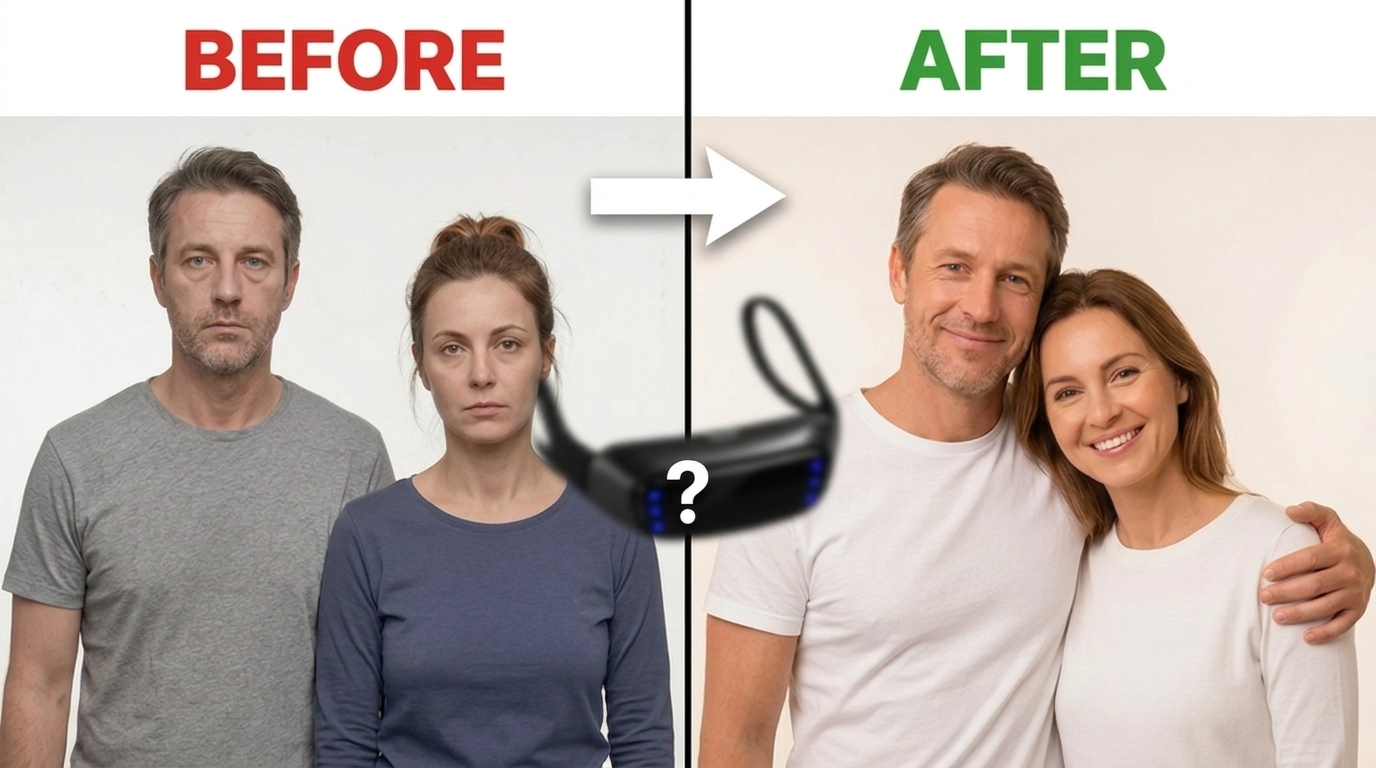
From worn out to well rested.
I need you to pay attention to every word. Don't skip anything.
I'm not asking you to read this for the sake of it. I'm sharing something that could change the way you think about your health — and potentially save your life. I'm not making that statement casually.
I've spent more than 20 years working with people suffering from snoring and sleep apnea. I've listened to thousands of stories, and there's a good chance I already understand what you're going through. Because I've heard the same struggles repeated time and time again.
You're constantly exhausted. Not the ordinary kind of tiredness, but a deep, relentless fatigue that leaves you feeling as though you've barely slept, even after eight hours in bed.
Your partner may have stopped complaining about your snoring. But that doesn't mean the problem has disappeared. Maybe they've moved into another bedroom. Maybe frustration has quietly turned into resentment. And perhaps you're beginning to worry that your relationship is paying the price.
Your mind doesn't feel as sharp as it once did. You struggle to concentrate, forget little things, and lose track of conversations. Tasks that used to come naturally now feel difficult. You know something has changed, but you can't seem to get back to your old self.
Then there are the nights when you suddenly wake up gasping for air. Your heart is racing, panic sets in, and for a terrifying moment, you feel as though you've stopped breathing.
I've heard these experiences again and again. And there's one thing you need to understand:
Ignoring the problem won't make it disappear. Untreated sleep apnea can become a serious threat to your health, and the consequences can be far more dangerous than you realise.
Why Broken Sleep Deserves to Be Taken Seriously
I don't usually share messages like this. But after years of working with people who struggle with sleep disorders, I feel there's an important conversation happening far too quietly.
Here's something many people misunderstand about persistent snoring and sleep apnea:
The issue goes far beyond the sound someone makes while sleeping. It can be a sign that their breathing is being repeatedly disrupted.
When the airway narrows during sleep, snoring can occur. With obstructive sleep apnea, breathing may stop and restart repeatedly throughout the night. These interruptions can cause oxygen levels to fall, forcing the body to respond again and again — sometimes many times in a single hour.
And the effects can reach much further than a restless night.
→ Your blood pressure can rise. Repeated breathing interruptions place stress on the body, and untreated sleep apnea is associated with high blood pressure and increased cardiovascular risk.
→ Your heart faces additional strain. Oxygen fluctuations and repeated awakenings put pressure on the cardiovascular system. Untreated sleep apnea is linked to a greater risk of serious conditions, including stroke and heart disease.
→ Your mental sharpness can suffer. Persistent tiredness, difficulty concentrating, memory problems, and mood changes can all accompany disrupted sleep. These symptoms shouldn't automatically be dismissed as a normal part of getting older.
→ Your relationship may come under pressure. When one person snores and the other spends night after night struggling to sleep, frustration can build. Separate bedrooms, constant exhaustion, and growing resentment can gradually create distance between even devoted partners.
→ Everyday activities can become dangerous. Excessive daytime sleepiness can impair concentration and reaction times, making driving particularly risky. People with untreated sleep apnea may struggle to stay alert behind the wheel.
I'm sharing this because I've seen how easily people brush aside the warning signs. They assume the noise is harmless, put off seeking help, and continue struggling night after night.
Please don't assume persistent snoring is nothing to worry about. Recognising the problem and seeking appropriate medical advice could be an important step towards protecting your health, improving your sleep, and restoring peace in your relationship.
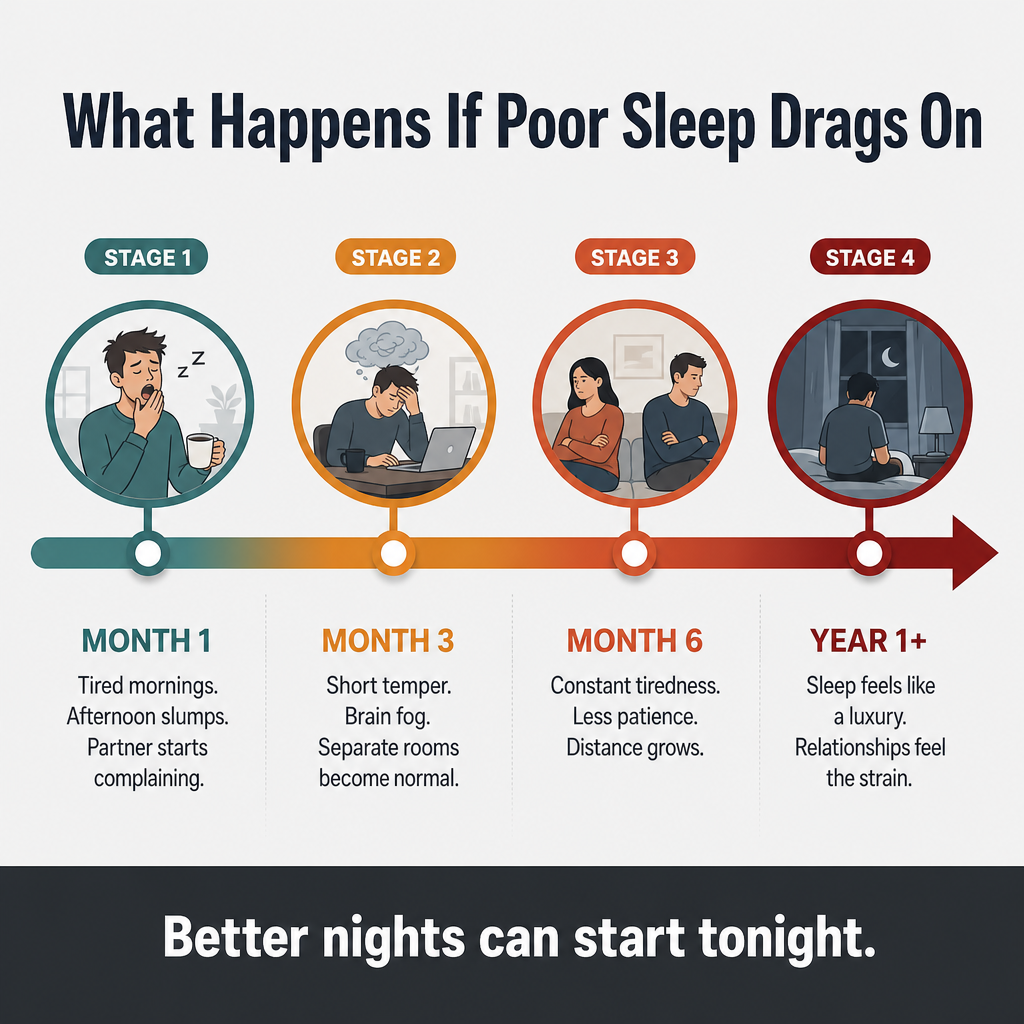
Poor sleep rarely feels urgent, which is why it drags on.
I went back and forth about including this next part. It's difficult to talk about, but I've heard too many people tell me they wish they'd recognised the problem earlier. I'd rather you understand the risks now than look back wishing you'd acted sooner.
Here's how ongoing snoring and untreated sleep apnea can affect your life as time goes on. Everyone's experience is different, but the potential consequences are serious enough that they shouldn't be ignored.
→ The First Year — Brushing It Aside
You tell yourself it's nothing serious. Your partner mentions the noise, you experiment with nasal strips or other quick fixes, and eventually you stop looking for answers. Meanwhile, your sleep remains disrupted, leaving you drained throughout the day. You blame your workload, stress, or getting older. The changes happen so gradually that you barely recognise how much your energy and wellbeing have suffered.
→ Years 2–3 — The Strain Builds
The exhaustion becomes harder to manage. Your blood pressure may rise, and concentrating or remembering everyday details feels increasingly difficult. You might seek help for individual symptoms without realising your sleep could be contributing to them. At home, your partner may start sleeping elsewhere. Neither of you wants another argument, so the subject gets avoided while the frustration continues to grow.
→ Around Year 5 — A Moment You Can't Ignore
Something finally forces you to pay attention. Perhaps a medical check reveals a problem, you experience a frightening moment of drowsiness while driving, or your partner admits how much the situation has affected them. You finally seek answers, wondering why you didn't do it sooner.
→ Years Later — The Long-Term Consequences
For some people, years of untreated sleep apnea contribute to serious cardiovascular complications, persistent cognitive difficulties, and lasting strain on relationships. Some consequences may be difficult to reverse. I've seen how deeply sleep problems can affect people's lives, particularly when the underlying issue goes unrecognised.
I'm sharing this because I'd rather you investigate the problem today than wait until it has taken a greater toll on your health and happiness.
Maybe you've only recently noticed the warning signs. Maybe you've been struggling for years. Either way, you don't need to wait for a crisis before taking your sleep seriously.
Please don't put it off.
So What's Really Behind Snoring?
When you fall asleep, the muscles around your throat relax. For many people, that narrows the airway slightly. Air squeezing past makes the soft tissue vibrate, and that vibration is the sound we call snoring.
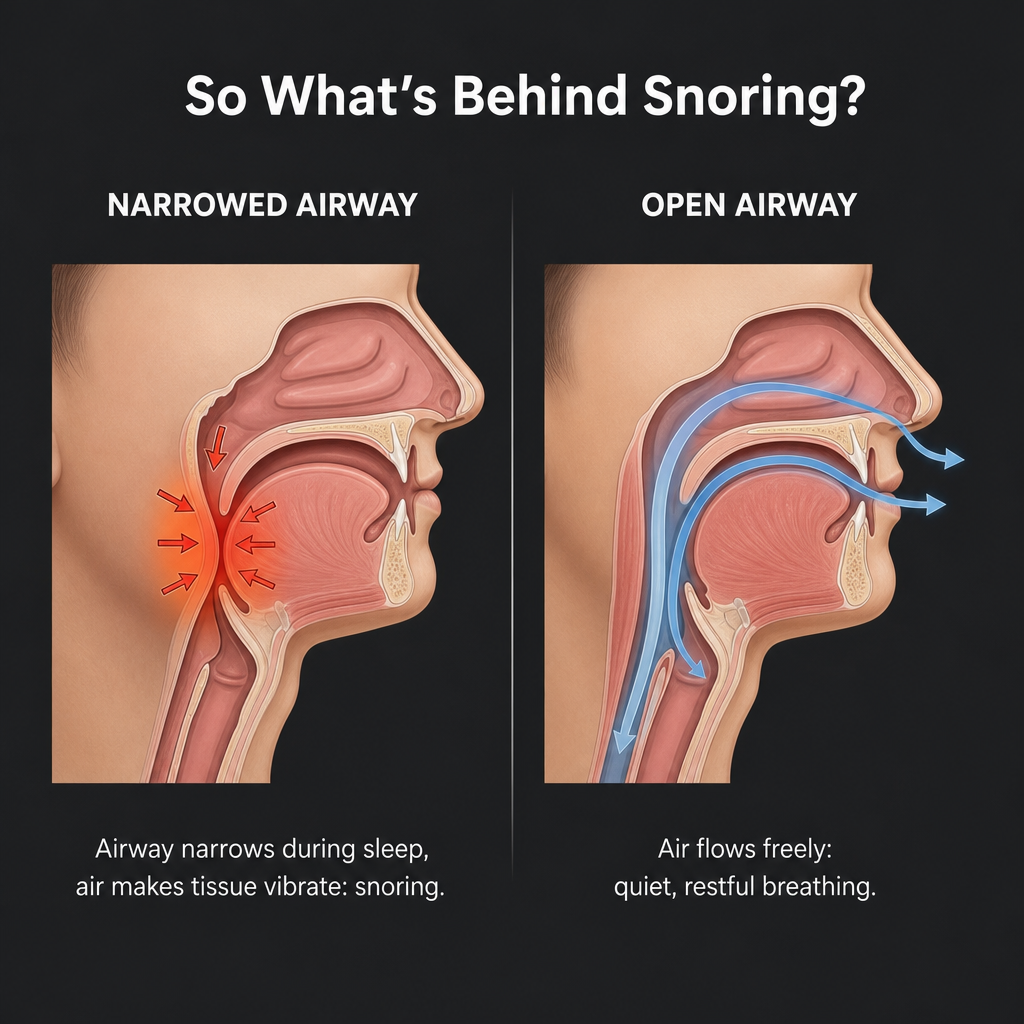
A narrowed airway makes the sound. An open airway doesn't.
Sleeping on your back, tiredness, evening alcohol, a blocked nose and simply getting older can all make it worse. That's why one fix can work for a friend and do nothing for you.
Why the Usual Fixes Let So Many People Down
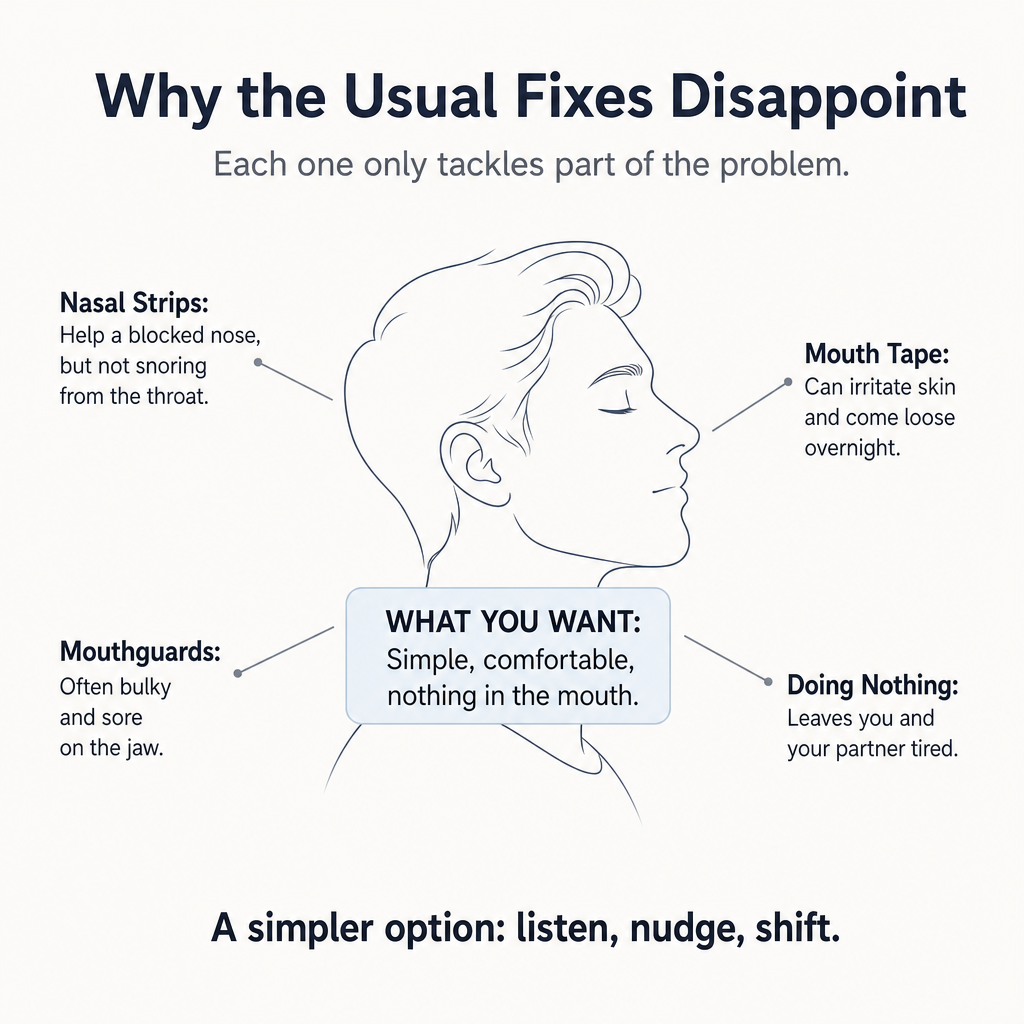
Each common fix only tackles part of the problem.
Nasal strips and tape
They can help a blocked nose, but do little when the noise starts further back in the throat. Tape can also irritate skin and come loose overnight.
Mouthguards
Some people get on well with them. Many find them bulky, and wake with a sore jaw. Custom-fitted ones can be expensive too.
None of these are bad ideas. They just don't suit everyone, and that's why so many people end up back where they started.
The Breakthrough I Wish I'd Found 10 Years Ago
A Different Approach: Listen First, Then Nudge
That's the idea behind the Lurva Chin Band.
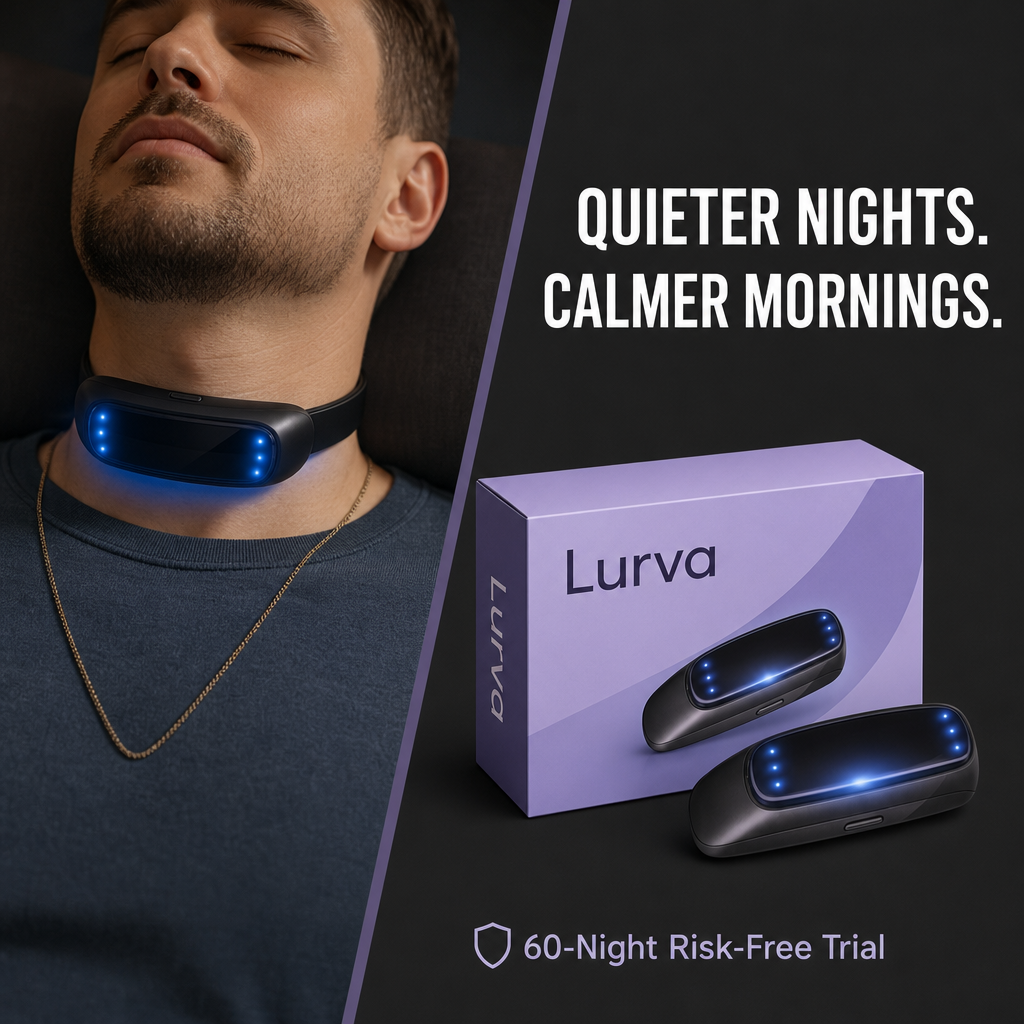
I'll be honest — when I first came across the Lurva Sleep Well Band, I wasn't convinced. Another gadget? Another bold promise? Another product claiming to solve a problem that so many people struggle with?
Then I examined the clinical data. I suggested it to several patients who hadn't found success with other approaches. And then I started seeing results that caught my attention.
✓ AHI readings moving in the right direction.
✓ Improvements in overnight oxygen levels.
✓ Partners getting in touch to share their relief.
I've now personally recommended the Lurva Sleep Well Band to more than 200 patients. It's the only solution I've found that aims to address the underlying issue — weak throat muscles — rather than simply covering up the symptoms.
Here's how it works:
The Lurva Sleep Well Band is a compact, lightweight device that sits beneath your chin while you sleep. It's discreet, quiet, and designed for comfortable overnight use.
It uses NEMS technology — Neuromuscular Electrical Stimulation — to deliver gentle electrical pulses to the muscles around your throat. These pulses are designed to stimulate and strengthen the muscles, helping to keep your airway open naturally.
No bulky mask. No hose. No mouthpiece. No surgery. Nothing covering your face or sitting inside your mouth.
You switch it on, settle into bed, and let the device do its job.
But here's the feature that really sets this approach apart:
The goal isn't to rely on a device forever.
After 60 days of consistent use, the vast majority of patients in this clinical programme no longer need the device. The idea is that their throat muscles have been retrained to maintain better tone independently. Snoring subsides, breathing improves, and the results are designed to last.
This isn't simply about managing symptoms. It's presented as a long-term solution.
More than 100,000 Americans have already completed the programme.
Discover the Lurva Chin Band →60-night risk-free trialLet Me Be Completely Honest With You
After 20 years of working with sleep disorders, I've seen too many people trapped in the same frustrating routine:
They dismiss the snoring. They experiment with nasal strips. When those fail, they try CPAP machines, struggle to tolerate them, and eventually stop using them. They move on to mouthguards, lose patience, and ultimately resign themselves to living with constant exhaustion.
All the while, their health may suffer, their relationships become strained, their performance at work declines, and the potential risks associated with untreated sleep apnea continue to grow.
I don't want to keep seeing people accept this as their normal life.
The Lurva Sleep Well Band offers a different approach. Rather than simply accepting the problem, it is designed to target the throat muscles involved in snoring and help support better airflow during sleep.
It's non-invasive. It's designed for comfort. And it fits into your nighttime routine without the bulk of a traditional CPAP setup.
The programme is designed around 60 days of consistent use, with the goal of helping users achieve lasting improvements. In the clinical results described here, most participants eventually stop needing the device.
The decision is yours. But after seeing what can happen when sleep problems are repeatedly ignored, I want you to consider what another year of exhaustion could mean for your health, your happiness, and the people closest to you.
Don't keep putting it off.
Your wellbeing matters. Your peace of mind matters. And the quality of your relationship matters.
Every night you spend struggling with poor sleep is another reason to investigate what's happening and find an approach that works for you.
If anything in this message sounds familiar, make tonight the moment you decide to take your sleep seriously.
The Lurva Sleep Well Band is presented in this story as a potential solution, backed by a 60-day money-back guarantee that allows customers to try it within the stated return period.
You Risk Nothing: Try It for 60 Nights
We want you to be sure before you keep it, so every Lurva comes with a 60-night trial.
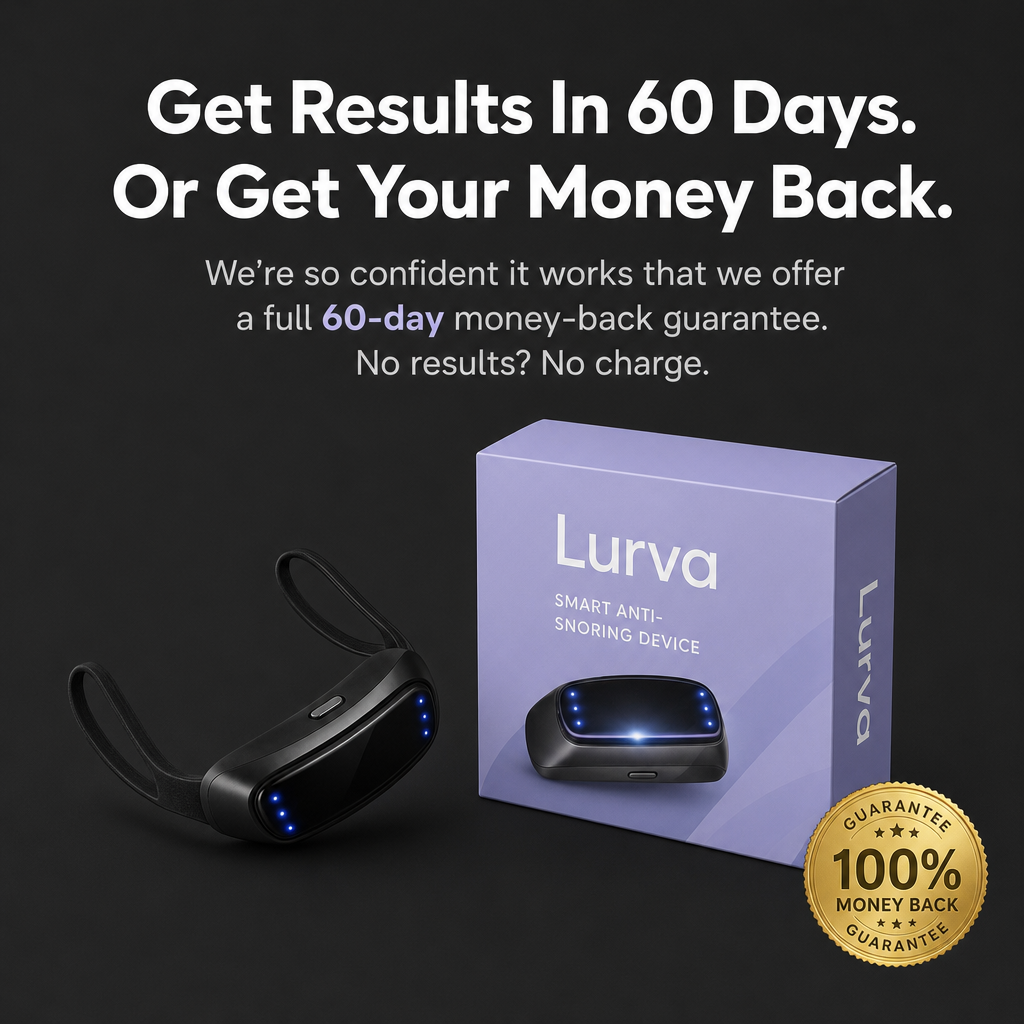
Use it for 60 full nights. If it isn't right for you, email support@lurva.com and we'll arrange a straightforward refund.
A Note About the Person Sleeping Next to You
Snoring is rarely a solo problem. It wears down two people's sleep, two people's patience, and sometimes two people's closeness.
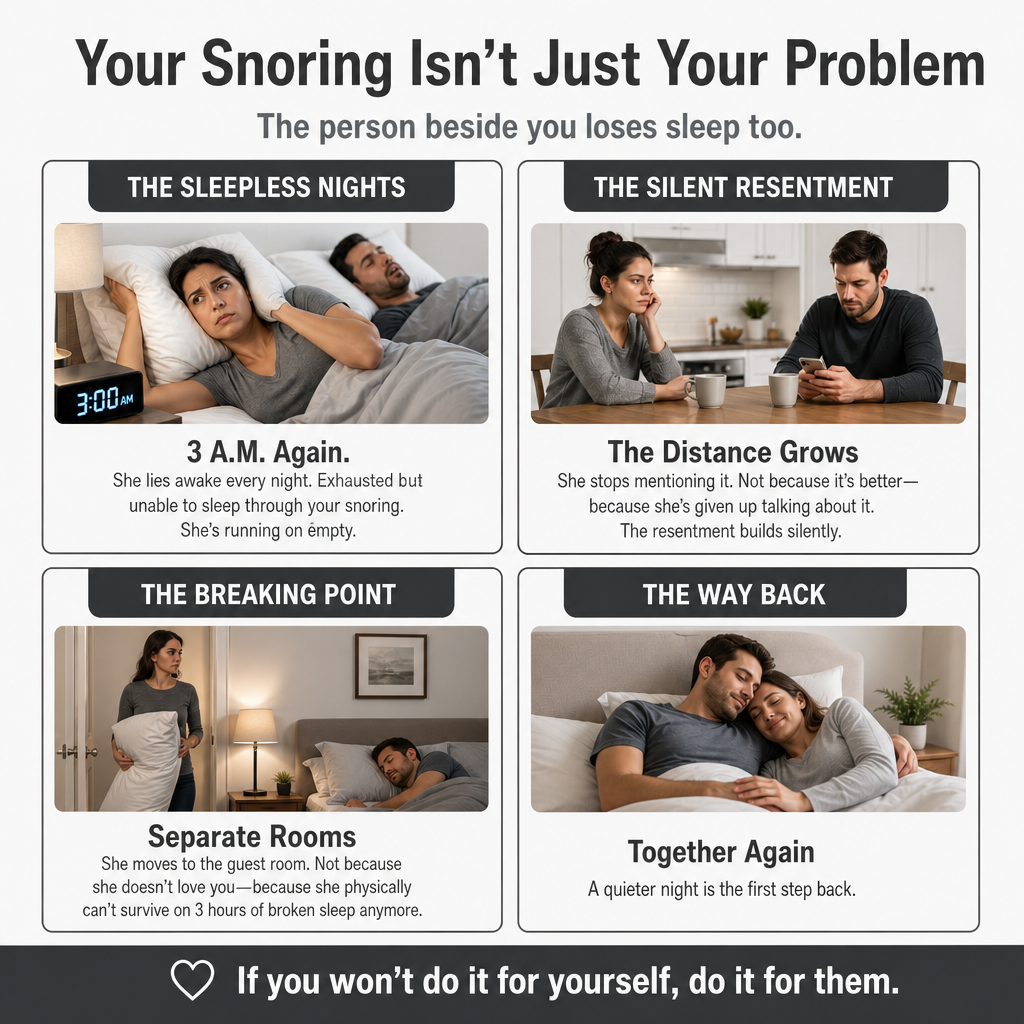
The person beside you loses sleep too.
If you won't do it for yourself, do it for them. A quieter night can be the first step back to sharing a bed.
How Does It Work? Set Up Takes About 30 Seconds
One thing people tell us they like is how simple it is. There's no fitting appointment and no learning curve.
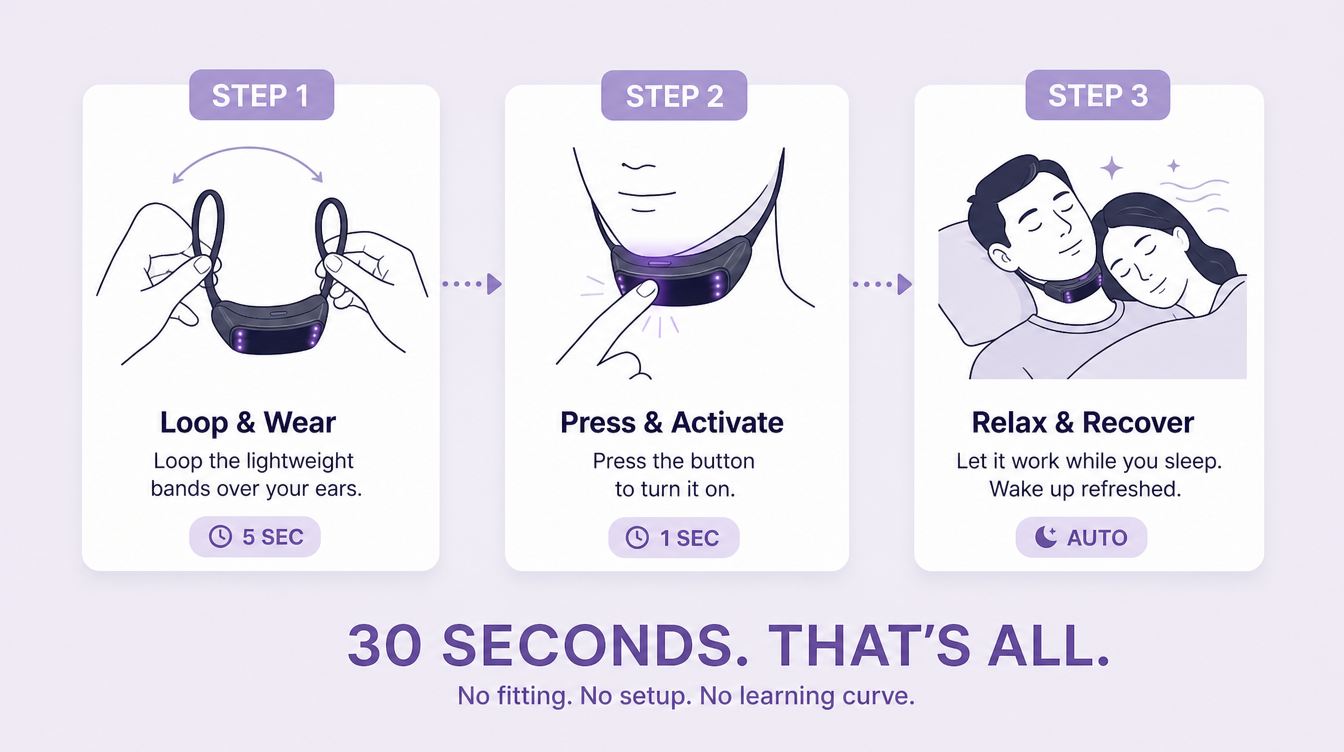
Step 1: Loop it under your chin before bed.
Step 2: Press the button and choose your vibration level.
Step 3: Go to sleep. Lurva listens through the night.
What to Expect in Your First Two Weeks
Everyone is different, so results vary. Here is what many people describe.
The first few nights
Give yourself time to find a comfortable fit and the right vibration level. Many people start low and turn it up only if needed.
Week one
Partners are often the first to notice. A quieter room is hard to miss.
Week two
With calmer nights, many people say they wake feeling more refreshed. Use it nightly for a fair picture.
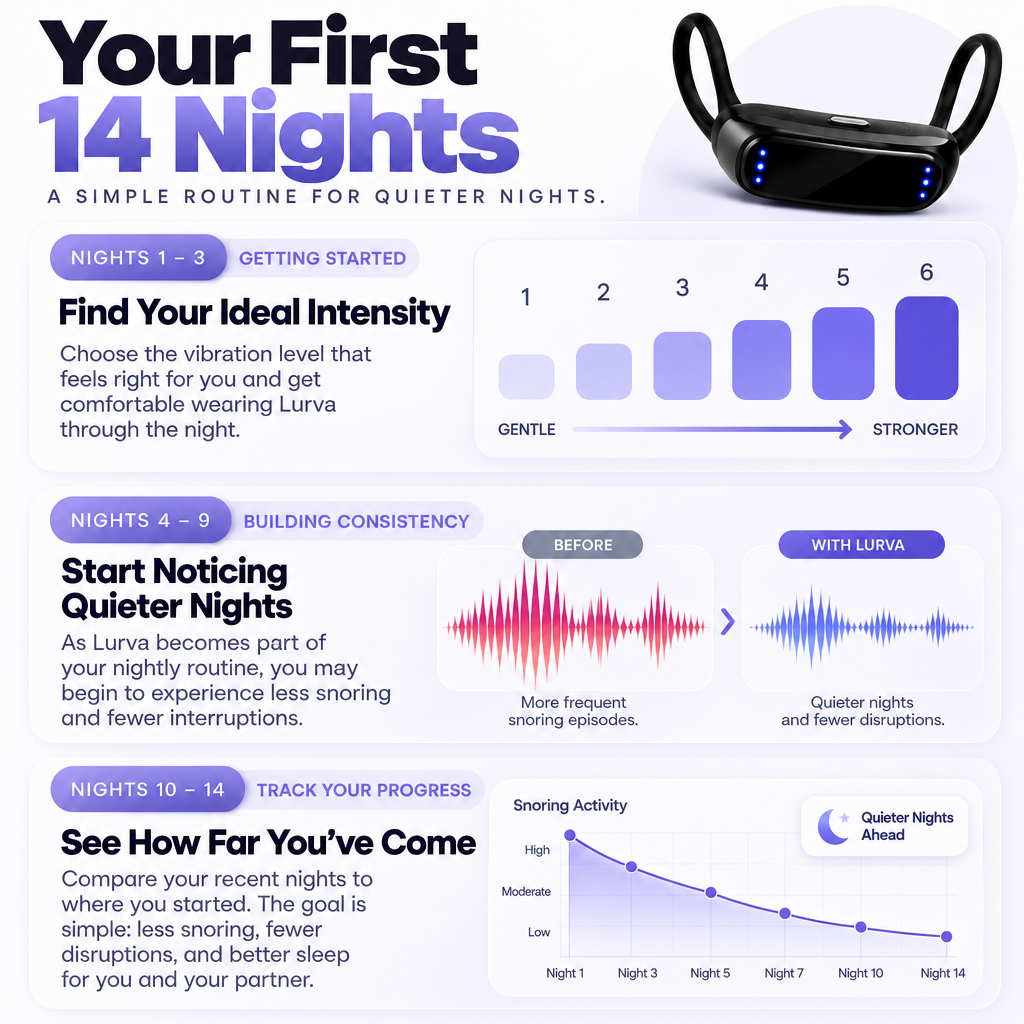
A simple routine for quieter nights.
See What Your First Night Could Feel Like →Questions We Hear Every Day
Will I feel the vibration?
You choose the strength. Go low for a gentle nudge or higher for a firmer one. Most people settle on a level within a few nights.
Is it comfortable to sleep in?
It's lightweight and sits under your chin. Nothing goes in your mouth or nose, and there's no adhesive.
What if I move around a lot in my sleep?
The strap is adjustable so it stays in place. If it feels loose, tighten it slightly.
How long does the battery last?
It charges over USB-C, and a full charge lasts around 10 nights. Exact life depends on how often it activates.
Is it a treatment for sleep apnea?
No. Lurva is designed for everyday snoring and is not a medical device or treatment. If you wake gasping, feel very sleepy in the daytime, or suspect sleep apnea, please see a healthcare professional.
I've tried a lot already. Why would this be different?
We can't promise it will work for everyone, which is why there's a 60-night trial. You can find out for yourself without risk.
What if it doesn't work for me?
You have 60 nights to try it. If it isn't for you, contact us for a refund.
Advertorial. Lurva is designed to help reduce everyday snoring and is not a medical device. It is not a treatment for sleep apnea. Individual results vary. If snoring persists or you have health concerns, please speak with a doctor.